
Cutting Fume Cupboard Running Costs with Variable Speed Drives

James Cox
Project Manager
Estimated reading time: 7 minutes
An extraction fan running flat out, 24 hours a day, is one of the biggest hidden running costs on a laboratory's energy bill. A variable speed drive (VSD) can cut that cost dramatically, but only if it's fitted the right way. Turn a fan down carelessly and you risk breaching the containment performance your fume cupboard was type tested for.
This guide covers the physics behind the savings, why you can't just wire a VSD to a dial and turn it down, and a worked example showing what the numbers actually look like on a bank of fume cupboards.
What a VSD Actually Does
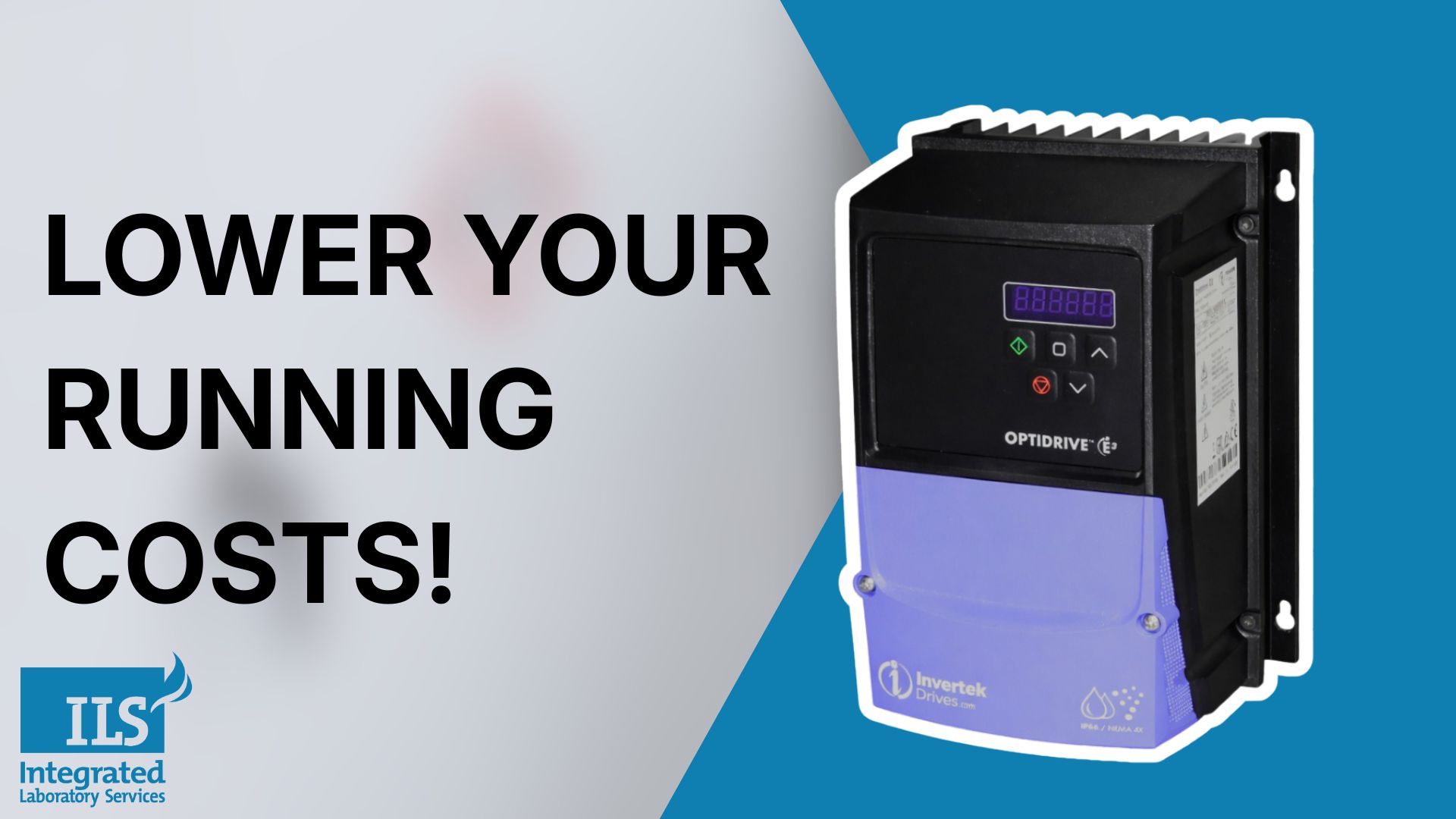
A VSD (also called an inverter, variable frequency drive, or VFD) changes the frequency of the electrical supply to the fan motor, which changes the motor's rotational speed. That's fundamentally different from a damper, which keeps the motor running at full speed and simply throttles the airflow mechanically: the motor still does most of the work, it just pushes air against more resistance.
They achieve this by taking the fixed 50Hz three-phase mains supply and outputting a lower frequency to the motor terminals. Motor speed follows frequency almost directly, so most extraction fan retrofits only trim the drive down to somewhere in the 35 to 40Hz range, not further: at 40Hz the motor runs at roughly 80% of its 50Hz speed, and at 35Hz roughly 70%. It looks like a modest adjustment on the drive's keypad, but because of the cube law below, it's enough to meaningfully cut the power bill.
Damper Trim Control
Motor runs at full speed continuously. A damper restricts flow mechanically. Simple and cheap to fit, but most of the electrical energy is still consumed: you're braking the airflow, not the motor.
VSD Speed Control
Motor actually slows down to match demand. Because power draw falls with the cube of speed, a modest speed reduction gives a disproportionately large energy saving.
The Physics: Fan Affinity Laws
Centrifugal and axial fans follow a well-established set of relationships called the fan affinity laws. For a fixed system, as fan speed (N) changes:
Flow (Q) ∝ N
Pressure (P) ∝ N²
Power (W) ∝ N³
That cube relationship on power is what makes VSDs so effective. Drop the fan speed by 20% (in practice, dialling the drive back from 50Hz to 40Hz) and power consumption falls to roughly 51% of full load, not 80%. Drop it by half (25Hz) and power falls to just 12.5% of full load. Small, well-controlled speed reductions produce disproportionately large savings.
Worth noting: real-world savings sit a little below the theoretical curve. Motor efficiency drops off at low loads, the VSD itself has switching losses (typically 2 to 4%), and any fixed resistance in the system (filters, bends, minimum discharge velocity) doesn't scale down with speed. Budget for savings a little under the pure cube-law prediction.
VSD vs Damper Trim on a Fume Cupboard Extract
On a fume cupboard extract, a damper does something a bit more consequential than on a general ventilation system: it changes the static pressure the fan sees without changing the fan's own speed. The motor keeps spinning at full 50Hz and drawing close to its full rated power, just against more resistance, so almost none of the cube-law saving below is available to a damper-trimmed system.
On a shared multi-cupboard manifold, like the K8 bank below, this matters beyond the running cost. Closing a damper on one branch shifts the pressure balance across the whole duct run, which can push face velocity on a neighbouring cupboard outside its type-tested range without anyone touching that cupboard's own controls. A VSD avoids this because it slows the fan itself: flow and pressure drop together, in line with the fan affinity laws above, rather than the fan fighting a closed damper.
Worked Example: A Bank of K8 Fume Cupboards
Take the 3No. 1500mm K8 fume cupboard bank used in our K8 series examples elsewhere on this site, drawing 3,240 m³/h at full design flow, with a 1.1 kW extract fan motor sized for that duty. Many systems like this were originally commissioned with a damper: the motor runs flat out on the 50Hz mains supply, and a damper trims the excess flow down to the correct design duty. Installing a VSD and setting the drive to output 40Hz instead, so the motor runs at roughly 80% speed, removes the need for the damper and lets the fan actually slow down to meet that same duty.
| Line frequency | Fan speed | Motor power (cube law) |
|---|---|---|
| 50Hz | 100% | 1.10 kW (100%) |
| 40Hz | 80% | 0.56 kW (51%) |
| 30Hz | 60% | 0.24 kW (22%) |
| 25Hz | 50% | 0.14 kW (12.5%) |
Setting the drive to 40Hz puts motor power at roughly 0.56 kW, against 1.10 kW running flat out on the damper-trimmed 50Hz supply, for the same design duty. Over a full year of continuous running (8,760 hours) at a representative UK small-business electricity rate of 27.8p/kWh (February 2026 average):
That's an illustrative saving of around £1,307 a year (about 49%) on this one fan, purely from correctly setting the drive to 40Hz instead of running the same motor flat out at 50Hz against a damper, before accounting for VSD switching losses and the minimum discharge velocity floor, which will shave a bit off the theoretical number in practice. It's a smaller headline figure than a deeper speed cut would give, but it's the realistic retrofit case: face velocity has to stay inside the type-tested envelope, and a 20% frequency reduction is often as far as a system with typical design margin can go without moving to full closed-loop VAV control. Real payback depends on your actual usage pattern, tariff, and existing control gear, but it shows why even a modest 50Hz-to-40Hz VSD on continuously-run extraction typically pays back in one to three years: the damper it replaces was wasting almost all of that difference as heat and noise rather than saving any energy at all.
Summary
| Parameter | Value |
|---|---|
| Fan motor rating | 1.1 kW |
| Damper-trimmed annual cost (50Hz) | ≈ £2,679 |
| VSD-trimmed annual cost (40Hz) | ≈ £1,372 |
| Illustrative annual saving | ≈ £1,307 (~49%) |
| Compliance requirement | Closed-loop face-velocity control per BS EN 14175-6; re-test under COSHH Reg 9 after retrofit |
Assumptions
- Fan motor rated 1.1 kW at full design duty (3,240 m³/h for a 3No. 1500mm K8 bank), driven from a 50Hz three-phase mains supply
- Baseline case: excess flow trimmed with a damper, motor still running at full 50Hz speed
- Retrofit case: VSD set to output 40Hz to the motor (80% of line frequency), within the typical 35 to 40Hz range used for extraction fan speed trims
- Continuous 24/7 running (8,760 hours/year), typical for extraction run for containment
- Electricity price of 27.8p/kWh, UK small-business average, February 2026
- Theoretical cube-law savings before VSD/motor part-load losses (typically 2 to 4%) and minimum discharge velocity constraints
- Assumes the fan was sized with enough margin that a straight 40Hz trim still keeps face velocity within the type-tested range; if not, closed-loop VAV control per BS EN 14175-6 is needed instead of, or as well as, the frequency trim
Thinking About Upgrading Your System?
Looking to install a new extraction system or upgrade an existing system, we can help! We design and install fume cupboard and laboratory extraction systems across the UK.